In industries where even the smallest micro-interruption can lead to serious consequences, whether in railway systems, industry, defense, telecommunications, or the medical sector, reliability is not optional
But what does this actually mean for our partners?
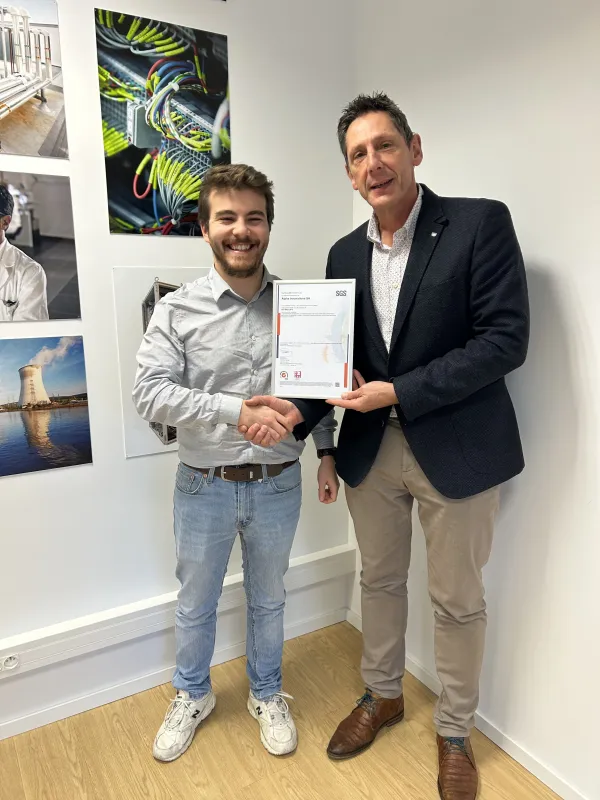
A culture of reliability embedded in our DNA
For many standardized suppliers, ISO 9001 is often perceived as merely a box to tick during a tender process. For us, it represents the formal recognition of our core DNA as a custom engineering partner.
As a partner in your energy transition, our mission is to deliver power supply and monitoring solutions that adapt to your operational constraints, not the other way around. This certification confirms that every stage of your project follows a rigorous and fully traceable protocol.
For you, the tangible outcome is clear: achieving full control over your operational expenditures (OPEX) while significantly reducing downtime to guarantee uninterrupted service continuity.
Zero tolerance for approximation
Designing critical systems requires surgical precision. Our quality approach is built on uncompromising validation phases. Our solutions comply with the most demanding safety standards on the market, including SIL4 compliance for railway and are certified according to European (CEBEC) and American (SGS) requirements.

Before any solution leaves our production facility, it undergoes a comprehensive series of evaluations:
- Functional testing - to ensure nominal performance within your operational environment
- Thermal testing – to guarantee resilience, even under extreme conditions
- Safety testing – to safeguard both your equipment and your teams
- EMC testing – to ensure interference-free operation
Building tomorrow’s critical energy infrastructure today
ISO 9001 certification forms part of a broader performance dynamic at Alpha Innovations. It reinforces our Ecovadis Silver rating, placing us among the top 15% of companies worldwide for our commitments to sustainability and transparency, as well as our recognition as a “Factory of the Future.”
These distinctions are not merely commercial trophies. They represent a commitment: to build, alongside our partners, energy infrastructures capable of meeting tomorrow’s challenges.
Let's discuss your specific needs
Other News

Reactivity Saves Lives!
May 20, 2020
![[Understanding SIL4]: Why the highest Safety Integrity Level is critical for railway safety](/sites/default/files/styles/medium/public/2026-06/stop-warning-sign-rails-station.jpg.webp?itok=U6VrfUsP)
Understanding SIL4: Why the highest Safety Integrity Level is critical for railway safety
Jul 2, 2026
![[From ARMADA to Inview Mesh]: The New Cockpit for Your Energy Assets](/sites/default/files/styles/medium/public/2026-02/Gemini_Generated_Image_8nz4ot8nz4ot8nz4.png.webp?itok=YxDR9cMm)
From ARMADA to Inview Mesh: The New Cockpit for Your Energy Assets
Oct 31, 2025

Alpha Innovations achieves ISO 9001 certification
Mar 11, 2026

How Belgian engineering secures railway punctuality
Feb 11, 2026

9 Years of Alpha Innovations
Apr 6, 2026

A strategic partner in the SENTINEL Project (EDF 2024)
Mar 25, 2026

New Look, Same Expertise: The Evolution of Alpha Innovations
Apr 8, 2026
CE+T Group advances Defence strategy at Eurosatory 2026
Jun 16, 2026
![[Reflecting on BEDEX 2026]](/sites/default/files/styles/medium/public/2026-03/Capture%20d%E2%80%99%C3%A9cran%202026-03-24%20%C3%A0%2016.53.04.png.webp?itok=n3lRCDEG)
Reflecting on BEDEX 2026
Mar 16, 2026

10th Edition of Rock Against Cancer
Mar 11, 2026

Alpha Innovations has been awarded the Factory of the Future label
Apr 20, 2024